
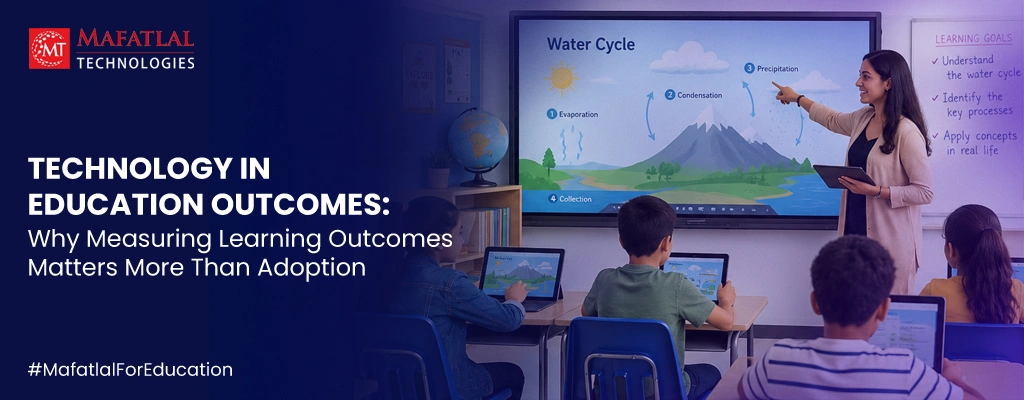
Technology in Education Outcomes: Why Measuring Learning Outcomes Matters More Than Adoption
- Admin
Walk into a modern classroom today, and you’ll notice something immediately screens, smart boards, tablets, learning apps, and digital platforms everywhere. On the surface, it feels like progress. But schools across the world are now asking a much deeper question: how much are these innovations truly improving technology in education outcomes for students, teachers, and institutions?
Is technology actually improving learning, or is it simply changing how learning looks?
Because adopting technology is easy. Measuring learning outcomes is where the real challenge begins.
Over the last decade, educational institutions have rapidly embraced digital transformation. From online learning platforms to AI-enabled classrooms, schools have invested heavily in educational technology. Yet many institutions still struggle to answer one important question:
Are students learning better?
This is where the conversation must evolve from simply introducing technology into classrooms to understanding the real Technology in education outcomes.
The future of education is no longer about being digitally equipped. It is about becoming insight-driven, student-focused, and outcome-oriented.
The Shift: From Adoption to Outcomes
For years, schools focused on bringing technology into education by:
- Installing smart boards
- Introducing tablets and digital devices
- Adopting online learning platforms
- Digitising academic content
- Conducting virtual assessments
This shift was important. It modernised classrooms and increased accessibility.
But over time, educators realised something critical:
Technology adoption alone does not guarantee better learning.
Many schools today have advanced digital tools but still face challenges such as:
- Students struggling with conceptual understanding
- Learning gaps going unnoticed
- Low engagement levels
- Inconsistent academic performance
- Limited visibility into student progress
This is why educational institutions are now shifting their focus from simply using Technology in classrooms to measuring real Technology in education outcomes.
Because the true success of educational technology lies not in usage but in impact.
Why Measuring Learning Outcomes Matters More Than Ever
Traditional education systems often measure performance through marks and examinations.
But marks only tell part of the story.
They do not fully reveal:
- Concept clarity
- Learning behaviour
- Student engagement
- Skill development
- Progress over time
- Individual learning challenges
A student may score well in an exam but still struggle with applying concepts in real-world situations.
This is why measuring learning outcomes has become one of the most important priorities in modern education.
Outcome-focused learning helps schools understand:
- How students are learning
- Where they are struggling
- Which teaching methods are effective
- What interventions are needed
- How learning evolves over time
And this is where technology becomes truly powerful not as a content delivery tool, but as a system for understanding learning itself.
The Evolving Role of Technology in Classrooms
In the early stages of EdTech adoption, most digital tools focused on accessibility.
Schools introduced:
- Video-based learning
- Digital content libraries
- Online classes
- Smart presentations
- E-learning portals
While these innovations improved access to education, the role of Technology in classrooms is now evolving into something much deeper.
Modern educational technology enables:
- Real-time student performance tracking
- Data-driven teaching decisions
- Adaptive learning systems
- Interactive classroom engagement
- Continuous assessments
- Skill-based progress monitoring
Today’s digital classrooms are becoming intelligent learning ecosystems where technology supports not just teaching, but also learning analysis and student growth.
With initiatives like NEP 2020 encouraging digital transformation and personalised learning, schools are increasingly adopting systems that focus on measurable academic outcomes rather than just digital presence.
AI in Education Impact: Turning Data Into Actionable Insights
One of the biggest advancements in modern education is the growing AI in education impact.
Artificial Intelligence is transforming classrooms from reactive environments into proactive learning systems.
Instead of waiting for final exams to identify struggling students, AI-powered educational platforms can now:
- Analyse learning patterns in real time
- Detect academic gaps early
- Predict performance challenges
- Recommend personalised interventions
- Adapt learning paths based on student needs
The process is simple, yet incredibly impactful:
Collect learning data → Analyse patterns → Generate insights → Improve outcomes
This shift changes technology from a passive classroom tool into an active learning support system. More importantly, AI helps educators make faster, smarter, and more informed academic decisions. And when teachers gain better visibility, students receive better support.
Personalized Learning: The Future of Student Success
Every student learns differently. Some students grasp concepts quickly. Others need repetition, visual explanations, or additional guidance. Traditional classrooms often struggle to accommodate these differences at scale.
This is where personalised learning powered by educational technology becomes transformative.
Modern learning systems can now:
- Adapt lesson difficulty levels
- Recommend customised practice activities
- Track individual progress
- Create flexible learning pathways
- Support both advanced and struggling learners
This approach improves:
- Student engagement
- Academic confidence
- Knowledge retention
- Classroom participation
- Long-term learning outcomes
The future of education is no longer one-size-fits-all.
It is personalised, adaptive, and learner centric.
The Real Challenge: When Technology Is Not Integrated
Despite massive investments in digital education, many schools still struggle to create meaningful outcomes.
The reason is often not the technology itself but the lack of integration.
When educational systems operate in silos:
- Teachers feel overwhelmed
- Data remains underutilised
- Learning becomes fragmented
- Insights become difficult to interpret
- Administrative burden increases
Technology should simplify education, not complicate it.
This is why schools need integrated ecosystems where assessments, analytics, content, classroom engagement, and reporting work together seamlessly. Without integration, technology creates noise. With integration, technology creates clarity.
What Outcome-Focused Educational Technology Looks Like
Outcome-driven schools ask a very different question.
Not:
What technology do we have?
But:
What impact is this technology creating?
An effective outcome-focused system should:
1. Track Learning Beyond Marks
Focus on concept understanding, skill development, and continuous progress.
2. Enable Real-Time Intervention
Identify academic challenges early and provide immediate support.
3. Support Personalized Learning
Adapt learning experiences according to each student’s pace and needs.
4. Empower Teachers With Insights
Provide actionable data that helps educators make informed decisions.
5. Align With Future-Ready Education Goals
Support competency-based learning, NEP 2020 objectives, and long-term student development.
Measuring What Truly Matters
When schools focus on Measuring learning outcomes, the transformation becomes visible across the entire learning ecosystem.
The impact includes:
- Better student understanding
- Improved classroom engagement
- Reduced learning gaps
- Higher academic consistency
- Stronger teacher confidence
- More effective decision-making
Most importantly, learning becomes:
✔ Visible
✔ Trackable
✔ Actionable
✔ Outcome-driven
And that creates classrooms where students are not just taught but truly understood.
How Mafatlal Technologies Supports Outcome-Driven Education
At Mafatlal Technologies, the focus goes beyond digital adoption.
The goal is to help educational institutions build smarter, connected, and outcome-focused learning environments.
What Mafatlal Technologies Enables
1. Intelligent Academic Tracking
Helping schools monitor student progress beyond traditional examinations.
2. Data-Driven Learning Insights
Transforming raw academic data into actionable educational decisions.
3. Personalized Learning Ecosystems
Supporting adaptive learning experiences for diverse student needs.
4. AI-Enabled Educational Solutions
Leveraging the growing AI in education impact to improve visibility, engagement, and outcomes.
5. Integrated Digital Infrastructure
Creating seamless ecosystems where content, analytics, assessments, and classroom management work together efficiently.
The Way Forward: Smarter, Not Just Digital
The future of education is not about adding more technology into classrooms.
It is about using technology more intelligently.
Schools that will lead the future are the ones that:
- Move beyond technology adoption
- Focus on measurable outcomes
- Use learning data meaningfully
- Support teachers with actionable insights
- Prioritise student growth over system complexity
Because in the end:
Technology alone does not improve education.
The way we use it does.
Conclusion
From Tools to Transformation
The impact of technology on education is undeniable. But its true value lies not in how widely it is adopted it lies in how effectively it improves learning outcomes.
Today’s schools must move beyond simply being digitally equipped.
They must become:
- Outcome-driven
- Insight-led
- Student-centric
- Future-ready
At Mafatlal Technologies, we believe educational technology should do more than modernise classrooms. It should empower educators, personalise learning, and improve Technology in education outcomes in a meaningful way, ensuring better academic results for every learner. Our focus is not just on digital transformation but on how it translates into real Technology in education outcomes that can be measured and improved over time. Because the future of education is not just digital. It is intelligent, measurable, and deeply human.