
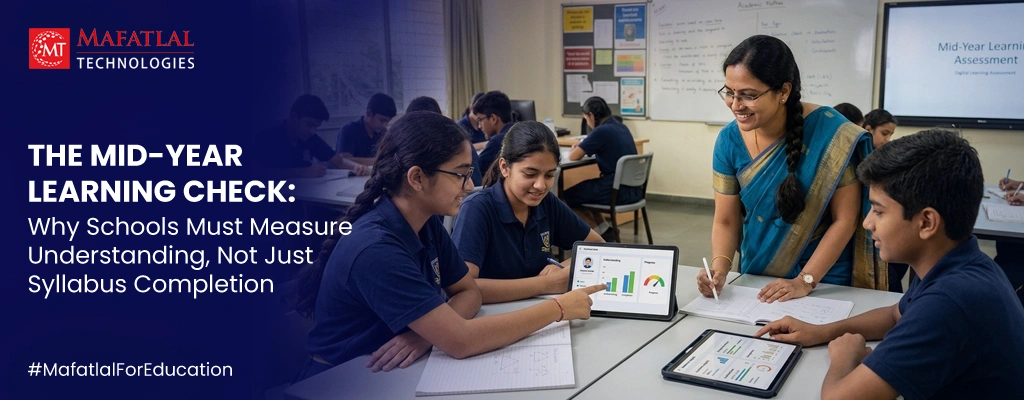
The Mid-Year Learning Check: Why Schools Must Measure Understanding, Not Just Syllabus Completion
- Admin
Completing the syllabus on time has long been considered a key indicator of academic success. However, finishing lessons does not always mean students have understood them. A mid-year learning assessment gives schools the opportunity to evaluate whether students have truly grasped concepts before moving further into the academic year. Mafatlal Technologies supports this approach by enabling schools to monitor student learning progress, identify learning gaps, and improve learning outcomes through data-driven academic insights. This article explores why understanding matters more than syllabus completion and how schools can make better academic decisions through regular assessments.
Why Syllabus Completion Alone Is Not Enough
Many schools measure academic progress by tracking how much of the curriculum has been covered. While syllabus completion is important, it only reflects teaching progress—not learning progress.
A class may complete every chapter according to schedule, but students may still struggle to apply concepts during assessments or classroom discussions. Without evaluating concept clarity, schools risk moving students forward without a strong academic foundation.
A mid-year learning assessment shifts the focus from "What was taught?" to "What was actually learned?"
What Is a Mid-Year Learning Assessment?
A mid-year learning assessment is a structured review conducted halfway through the academic year to evaluate students' understanding of key concepts rather than simply checking completed lessons.
Unlike final examinations, it is designed to:
- Measure student learning progress
- Assess concept understanding
- Identify learning gaps early
- Support timely academic interventions
- Improve future teaching strategies
It provides schools with valuable insights while there is still enough time to improve academic performance before year-end assessments.
Why Measuring Understanding Matters
True learning happens when students can understand, apply, and retain knowledge—not simply memorize information.
Schools that regularly monitor concept clarity can quickly identify students who need additional support.
For example, if an entire class completes a mathematics chapter but struggles with problem-solving exercises, the issue is not syllabus completion but concept understanding. A timely review allows teachers to revisit the topic before introducing more advanced concepts.
This approach strengthens long-term learning outcomes while improving student confidence.
- A student struggling with fractions may receive additional practice questions.
- Another student who has mastered the topic can move to advanced exercises.
- Students receive immediate feedback, helping them correct mistakes while learning.
This personalized approach improves student practice and encourages continuous learning outside the classroom.
Benefits of Conducting a Mid-Year Learning Assessment
A well-planned mid-year learning assessment offers benefits for students, teachers, and school leaders.
Better Student Learning Progress
Regular assessments provide a clearer picture of how students are progressing throughout the year instead of relying only on final examinations.
Improved Academic Performance
When learning gaps are identified early, teachers can provide additional practice, revision sessions, or personalized support before academic challenges become more serious.
Stronger School Assessment Practices
A comprehensive school assessment system helps educators evaluate both teaching effectiveness and student understanding, creating a more balanced approach to academic success.
More Meaningful Learning Outcomes
Schools can focus on concept mastery rather than memorization, leading to improved retention and long-term academic growth.
Best Practices for Effective Mid-Year Assessments
To maximize the value of a mid-year learning assessment, schools should follow a structured approach.
Focus on Concept Clarity
Assessments should evaluate students' ability to apply knowledge rather than simply recall facts.
Use Multiple Assessment Methods
Schools can combine:
- Written assessments
- Classroom observations
- Practical activities
- Oral discussions
- Project-based learning
This provides a more complete picture of student learning progress.
Review Results Quickly
Assessment data should be analyzed soon after completion so teachers can implement timely improvements.
Share Insights with Parents
Regular communication helps parents understand their child's progress and encourages collaborative support outside the classroom.
Common Mistakes Schools Should Avoid
Some schools conduct assessments but fail to use the results effectively.
Common mistakes include:
- Measuring only syllabus completion.
- Focusing exclusively on examination marks.
- Delaying academic interventions.
- Ignoring patterns in student performance.
- Treating assessments as administrative formalities.
A successful school assessment process should always lead to meaningful action that improves teaching and learning.
How Technology Supports Mid-Year Learning Assessments
Digital learning platforms make it easier for schools to monitor academic progress continuously.
Solutions like Medha from Mafatlal Technologies provide educators with real-time insights into student learning progress, concept clarity, and overall academic performance.
Instead of waiting until final examinations, principals and teachers can track learning trends throughout the academic year, identify students who need support, and make informed academic decisions based on reliable data.
This enables schools to strengthen learning outcomes while ensuring every student remains on the right learning path.
Conclusion
Completing the syllabus is only one part of academic success. The real measure of effective education is whether students understand, retain, and apply what they have learned. A mid-year learning assessment helps schools evaluate student learning progress, strengthen concept clarity, and improve academic performance before final examinations.
By focusing on understanding rather than completion, schools can make better instructional decisions, provide timely support, and achieve stronger learning outcomes for every student. In today's education landscape, measuring learning is far more valuable than simply measuring teaching.