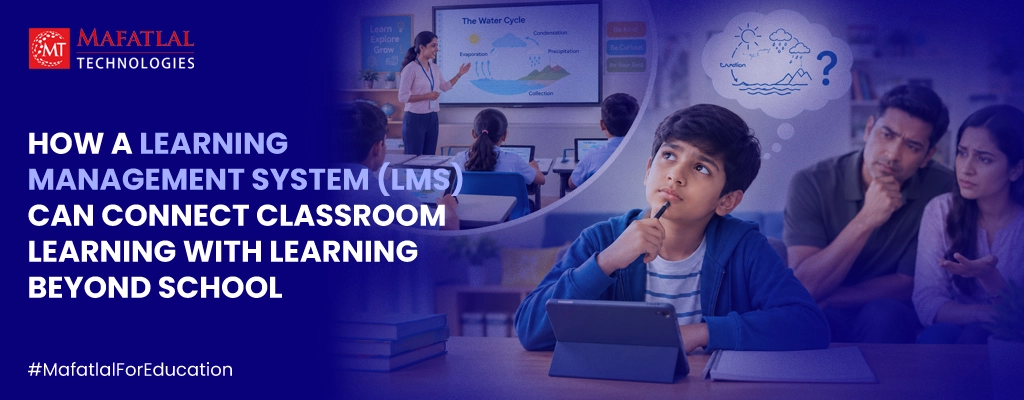
Learning Does Not End When the School Bell Rings
When Aarav returned home from school one afternoon, he remembered that his teacher had explained an interesting science topic in class. He wanted to understand it better, but his notebook was incomplete, and he could not remember every detail. His parents tried to help, but they were unsure how the topic had been taught in school.
Now imagine if Aarav could simply log in to a platform, revisit the lesson, explore additional learning materials, and complete a short activity at his own pace. Learning would no longer be limited to the classroom or school hours. It could continue wherever he was, whenever he needed it.
This is where a learning management system (LMS) can make a meaningful difference. By connecting teachers, students, and learning resources on a single platform, an LMS helps schools create a more connected learning experience that extends beyond the classroom.
What Is a Learning Management System (LMS)?
A learning management system (LMS) is a digital platform that helps schools organise, deliver, and manage learning activities. It allows teachers to share educational content, assign tasks, conduct assessments, and monitor student progress.
For students, it provides access to learning materials, activities, assignments, and other educational resources in one place. For teachers, it simplifies classroom management and helps them understand how students are progressing.
An effective LMS for schools brings classroom teaching and independent learning together. Instead of treating home learning as a separate activity, it creates continuity between what students learn at school and how they practise, revise, and explore those concepts afterwards.
1. Making Classroom Lessons Accessible Beyond School
Students learn at different speeds. Some understand a concept during the first explanation, while others need more time and practice.
A learning management system allows students to revisit shared lessons and resources after school. They can review topics, refer to digital study materials, and practise concepts before an examination.
This flexibility is especially useful when students miss a class, need additional revision, or want to explore a topic in greater detail.
With a digital learning platform, learning becomes less dependent on a fixed classroom schedule. Students can continue their learning journey at a pace that suits their needs, while teachers can provide resources that support classroom instruction.
2. Supporting Teachers Beyond Classroom Hours
A teacher's role does not end when a lesson is completed. Preparing assignments, answering questions, checking progress, and planning the next lesson are all part of the teaching process.
A school LMS can bring many of these activities together. Teachers can share learning materials, assign practice exercises, communicate instructions, and review student submissions through one platform.
This organised approach helps teachers maintain a connection with students beyond school hours without depending entirely on printed worksheets or scattered messages.
It also creates opportunities for teachers to identify topics that need further explanation and plan classroom discussions accordingly.
3. Encouraging Independent and Self-Paced Learning
Every student has a different learning style. Some prefer reading, while others understand concepts better through videos, visual explanations, or interactive activities.
A learning management system can offer different types of educational resources to support these preferences. Students can revisit lessons, practise through activities, and spend additional time on concepts they find challenging.
This encourages independent learning and helps students take greater responsibility for their progress.
Rather than simply completing homework, students can develop the habit of reviewing concepts, identifying doubts, and preparing for upcoming lessons. Over time, these habits can support confidence, curiosity, and better learning outcomes.
4. Bringing Classroom Learning and Home Learning Together
For learning to be effective, classroom teaching and home practice should complement each other.
For example, a teacher may introduce a mathematics concept in class, share practice questions through an LMS, and review common mistakes during the next lesson. Students can practise at home, while teachers can use their observations to plan further explanations.
This is an example of blended learning, where classroom instruction is supported by digital resources and activities.
A digital learning platform helps establish this connection by keeping learning materials, assignments, and activities organised. It also helps parents stay informed about learning activities and support their children's education at home.
When used thoughtfully, blended learning creates a more continuous experience rather than separating school lessons from independent study.
5. Helping Schools Understand Student Progress
Connecting learning across different environments also means understanding how students are progressing.
An LMS for schools can help teachers track assignment completion, assessment performance, participation, and other available learning indicators. These insights can help teachers recognise areas where students may need additional support.
For instance, if several students struggle with the same topic, a teacher can revisit it in class or provide additional practice materials.
However, technology should support a teacher's judgement, not replace it. Student progress is best understood through a combination of digital insights, classroom interaction, observation, and individual guidance.
How Mafatlal Technologies Supports Connected Learning
At Mafatlal Technologies, the focus is on helping schools create more connected and technology-enabled learning environments.
Its learning solutions, including LMS capabilities, support the organisation and delivery of educational content, helping teachers and students access learning resources beyond classroom hours. These capabilities can support lesson reinforcement, digital content access, assignments, and learning activities, depending on the school's implementation.
By bringing learning resources into a more organised digital environment, Mafatlal Technologies aims to help schools connect classroom teaching with independent learning and support teachers in their everyday academic activities.
The goal is not to replace the teacher or the classroom. It is to extend the value of classroom learning by making educational resources more accessible and supporting continuity between school and home.
Conclusion: Building a Connected Learning Experience
Learning happens in many places: during a classroom discussion, while completing homework, when revisiting a difficult concept, or while exploring a new subject out of curiosity.
A learning management system (LMS) can help connect these experiences by making educational resources accessible, supporting teachers, and encouraging students to learn independently.
For schools, adopting the right digital learning platform is an opportunity to create a more organised and flexible learning environment. When technology is combined with effective teaching and meaningful student engagement, learning can continue well beyond school hours.
Because education should not stop at the classroom door. It should give every student the opportunity to keep exploring, practising, and growing.