
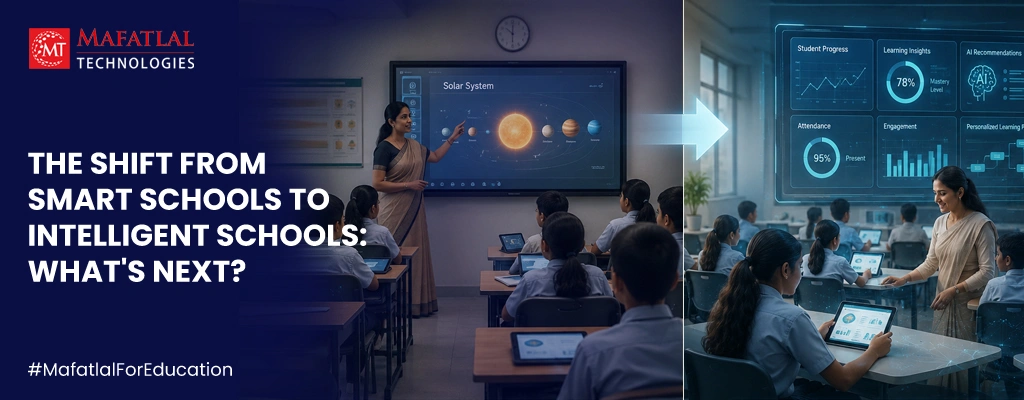
The Shift from Smart Schools to Intelligent Schools: What's Next?
- Admin
Technology has transformed classrooms over the last decade, but simply introducing digital devices is no longer enough. Today's intelligent schools are moving beyond smart boards and online content to create connected, data-driven learning environments. Mafatlal Technologies is helping schools make this transition by enabling educators to use AI, real-time insights, and academic intelligence to improve teaching and learning. This article explores how intelligent schools differ from smart schools, why this shift is important, and what school leaders can do to prepare for the future.
What Are Intelligent Schools?
Many smart schools have successfully adopted digital infrastructure such as interactive classrooms, online assessments, and learning management systems. While these technologies improve access to learning resources, they often focus on digitizing existing processes rather than transforming them.
Intelligent schools, on the other hand, use technology to support better decision-making. They combine AI in education, learning analytics, and automation to understand how students learn, identify challenges early, and personalize academic support.
Instead of asking, "Did students complete the lesson?" an intelligent school asks, "Did students understand the lesson?"
Smart Schools vs. Intelligent Schools
The difference between smart schools and intelligent schools goes beyond technology.
| Smart Schools | Intelligent Schools |
|---|---|
| Focus on digital infrastructure | Focus on learning intelligence |
| Use technology to deliver content | Use data to improve learning |
| Track attendance and activities | Monitor learning progress and concept mastery |
| Digital classrooms | AI-powered academic insights |
| Technology supports teaching | Technology improves decision-making |
This evolution reflects the next stage of digital transformation in education, where data becomes as valuable as technology itself.
Why Schools Are Making the Shift
Education today is becoming more complex. School leaders need timely information to improve learning outcomes, support teachers, and engage parents effectively.
An intelligent school provides this visibility through real-time academic insights.
The shift is driven by several factors:
- Growing adoption of AI in education
- Increased focus on personalized learning
- Demand for measurable learning outcomes
- Need for faster academic interventions
- Rising expectations from parents and educators
As schools continue their digital transformation, intelligence becomes the key differentiator rather than infrastructure alone.
How AI Is Powering Intelligent Schools
One of the biggest drivers behind intelligent schools is AI in education.
Artificial intelligence helps schools process large volumes of academic data and convert it into actionable insights.
For example, AI can:
- Identify students who need additional support.
- Predict potential learning gaps.
- Recommend personalized learning paths.
- Track concept mastery across subjects.
- Help teachers prioritize interventions.
Rather than replacing teachers, AI supports them by reducing manual work and enabling better academic planning.
This is why AI in education is becoming an essential component of modern school systems.
Education Innovation Beyond Digital Classrooms
Many schools believe installing smart boards or tablets is enough to become future-ready. However, true education innovation requires schools to rethink how technology supports learning.
Successful intelligent schools focus on:
- Continuous learning assessment
- Data-driven teaching strategies
- Teacher collaboration
- Personalized student support
- Real-time academic monitoring
Technology becomes valuable only when it helps educators make better decisions and improve student outcomes.
Best Practices for Building Intelligent Schools
Schools planning their transition should focus on long-term academic improvement rather than short-term technology adoption.
Some best practices include:
- Build a centralized academic dashboard.
- Use AI to monitor learning progress regularly.
- Train teachers to interpret learning data.
- Encourage data-driven academic planning.
- Review student performance continuously instead of only after examinations.
These practices help schools maximize the benefits of digital transformation while creating sustainable academic improvement.
Common Mistakes Schools Should Avoid
Many schools invest in technology but fail to realize its full value.
Common mistakes include:
- Purchasing technology without a clear academic strategy.
- Measuring technology adoption instead of learning outcomes.
- Ignoring insights generated through AI.
- Using digital tools only for administrative tasks.
- Failing to train teachers on new systems.
Avoiding these mistakes allows schools to build truly future-ready schools rather than simply modern classrooms.
How Mafatlal Technologies Supports Intelligent Schools
Mafatlal Technologies supports schools throughout their transformation journey by providing intelligent academic solutions through its Medha platform.
The platform combines AI in education, real-time learning analytics, curriculum tracking, and performance monitoring to help schools make informed academic decisions.
Instead of focusing only on digital adoption, Mafatlal Technologies enables schools to create connected learning ecosystems where students, teachers, and school leaders work together using actionable academic insights.
This approach helps institutions evolve into intelligent schools that continuously improve learning outcomes.
Conclusion
The future of education is no longer defined by digital infrastructure alone. While smart schools introduced technology into classrooms, intelligent schools use technology to improve every academic decision.