
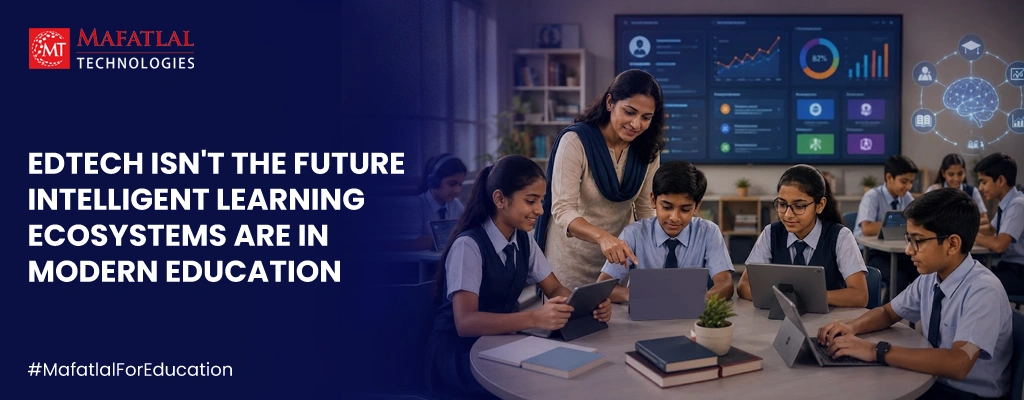
EdTech Isn't the Future Intelligent Learning Ecosystems Are in Modern Education
- Admin
A few years ago, introducing technology into classrooms was considered a major step forward. Schools invested in smart boards, digital content, online assessments, and learning management systems. The goal was simple: use technology to improve learning outcomes. But something interesting happened. Many institutions discovered that simply adding technology to classrooms didn't automatically improve student engagement, academic performance, or learning experiences. A school could have the latest devices and software yet still struggle to understand why certain students were falling behind, why engagement levels varied, or how teaching strategies could be improved.
The challenge wasn't technology itself. The challenge was that educational tools often operated in isolation. Data existed in multiple systems. Insights were fragmented. Teachers had access to information but not always the context needed to make meaningful decisions. This realization is reshaping the future of education. Today, educational institutions are moving beyond standalone EdTech solutions and embracing intelligent learning ecosystems connected environments where technology, data, analytics, educators, and learners work together to create more personalized, effective, and impactful learning experiences.
The future of education isn't about having more technology. It's about creating smarter systems that help every learner succeed.
What Are Intelligent Learning Ecosystems?
An intelligent learning ecosystem is a connected educational environment where various learning technologies, platforms, data sources, and stakeholders work together seamlessly.
Rather than functioning as separate tools, these systems integrate information across the learning journey to create a holistic view of student development.
An intelligent learning ecosystem brings together:
- Learning management systems
- Assessment platforms
- Student information systems
- Learning analytics tools
- AI-powered educational technologies
- Teacher insights
- Student engagement data
The result is a unified ecosystem that enables educators to make informed decisions while supporting personalized and adaptive learning experiences.
Instead of focusing solely on technology adoption, intelligent learning ecosystems focus on educational outcomes.
Why Traditional EdTech Is No Longer Enough
Over the past decade, educational technology has transformed how learning is delivered.
However, many institutions still face challenges such as:
- Fragmented learning data
- Limited visibility into student progress
- Difficulty identifying learning gaps
- Inconsistent student engagement
- Delayed interventions
Traditional EdTech solutions often address individual challenges but fail to connect the broader learning experience.
For example, a school may have separate systems for assessments, attendance, assignments, and communication. While each platform serves a purpose, they may not provide a complete understanding of student learning.
This is where intelligent learning ecosystems create value.
By integrating data and insights across multiple touchpoints, schools can move from reactive decision-making to proactive educational support.
Building Future-Ready Classrooms
The classroom of the future is not defined by the number of devices it contains.
Instead, it is defined by its ability to adapt, respond, and support diverse learner needs.
Future-ready classrooms combine technology, pedagogy, and data-driven insights to create flexible learning environments that prepare students for a rapidly changing world.
These classrooms enable educators to:
- Personalize learning experiences
- Monitor student progress continuously
- Foster collaboration and creativity
- Encourage critical thinking
- Support diverse learning styles
- Deliver timely interventions
Future-ready classrooms focus on empowering learners rather than simply digitizing traditional teaching methods.
They create environments where students actively participate in their learning journey and develop skills that extend beyond academic achievement.
The Role of Smart Education Technology
Technology remains an important part of modern education—but its role is evolving.
Today's smart education technology goes beyond content delivery and administrative automation.
Modern solutions leverage artificial intelligence, analytics, and automation to provide deeper insights into how students learn.
Smart education technology can:
- Analyse student learning patterns
- Recommend personalized learning pathways
- Identify academic risks early
- Support teacher decision-making
- Improve communication and collaboration
- Enhance overall learning experiences
The goal is not simply to digitize education but to make learning more intelligent, responsive, and effective.
Data-Driven Learning: Turning Information into Action
Educational institutions generate vast amounts of data every day.
Attendance records, assessments, classroom participation, learning activities, and performance metrics all contribute valuable information about student progress.
The challenge lies in turning this information into meaningful action.
This is where data-driven learning becomes essential.
By analysing educational data effectively, schools can identify trends, uncover learning gaps, and make informed decisions that improve outcomes.
Data-driven learning helps educators answer important questions:
- Which students need additional support?
- Which teaching methods are most effective?
- How can learning experiences be personalized?
- What factors influence student success?
When data is transformed into actionable insights, educators gain the ability to support students more effectively and proactively.
Why Learning Analytics Tools Matter
Data alone does not improve learning outcomes.
The real value comes from understanding what that data means.
This is where learning analytics tools play a critical role.
Learning analytics tools collect, analyse, and visualize educational data, helping educators gain a clearer understanding of student performance and engagement.
These tools help institutions:
- Track learning progress
- Monitor engagement levels
- Identify at-risk students
- Measure academic growth
- Evaluate instructional effectiveness
- Support continuous improvement
With access to meaningful insights, educators can make evidence-based decisions that drive better learning outcomes.
AI-Driven Student Engagement: A New Era of Learning
Student engagement remains one of the strongest indicators of academic success.
Yet maintaining engagement can be challenging in increasingly diverse and dynamic learning environments.
AI-driven student engagement is helping schools address this challenge by creating more personalized and responsive learning experiences.
AI-powered systems can:
- Recommend relevant learning resources
- Adapt content based on learner needs
- Identify disengagement patterns early
- Deliver personalized feedback
- Encourage continuous participation
When students receive learning experiences that align with their interests, abilities, and goals, engagement naturally increases.
AI helps educators create learning environments where students feel supported, motivated, and connected to their educational journey.
How Mafatlal Technologies Is Building Intelligent Learning Ecosystems
At Mafatlal Technologies, we believe the future of education lies not in isolated tools but in connected, intelligent learning environments that empower educators and learners alike.
Our education solutions are designed to help institutions move beyond traditional EdTech and embrace comprehensive learning ecosystems that support meaningful educational outcomes.
Through platforms like Medha, Mafatlal Technologies enables schools and educational institutions to:
Create Future-Ready Classrooms
We help schools build digitally connected learning environments that support collaboration, personalization, and student-centered learning.
Leverage Smart Education Technology
Our solutions integrate advanced technologies that simplify teaching, improve visibility into student progress, and enhance learning experiences.
Enable Data-Driven Learning
By centralizing academic and engagement data, educators gain actionable insights that support informed decision-making and continuous improvement.
Utilize Learning Analytics Tools
Real-time dashboards and analytics provide educators with a comprehensive understanding of student performance, helping identify learning gaps and opportunities for growth.
Improve AI-Driven Student Engagement
Intelligent learning solutions help personalize educational experiences, ensuring students remain motivated, engaged, and supported throughout their learning journey.
At Mafatlal Technologies, our mission is to help educational institutions build learning ecosystems that combine innovation, intelligence, and human expertise to deliver better outcomes for every learner.
The Future of Education Is Connected
The next phase of educational transformation will not be defined by individual technologies.
It will be defined by how effectively those technologies work together.
As schools continue to evolve, intelligent learning ecosystems will become the foundation for more personalized, data-driven, and learner-centric education.
Institutions that embrace connected learning environments will be better positioned to support student success, empower educators, and adapt to the changing demands of the future.
Conclusion
Technology has undoubtedly transformed education. But the future lies beyond standalone digital tools. Through intelligent learning ecosystems, schools can create connected environments that combine smart education technology, data-driven learning, learning analytics tools, and AI-driven student engagement to deliver more meaningful educational experiences.
The goal is no longer to simply digitize learning. The goal is to create intelligent systems that help every learner reach their full potential while preparing them for success in an ever-changing world.