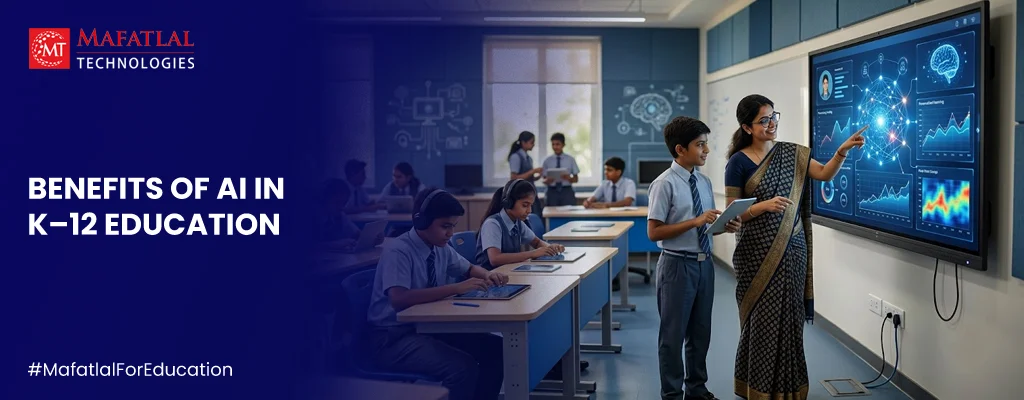
Education is changing rapidly, and technology is becoming an increasingly important part of how students learn. From digital classrooms to intelligent learning platforms, schools are exploring new ways to make learning more engaging, accessible, and personalized. One of the most significant developments in this space is AI in K–12 education.
Artificial intelligence is no longer limited to research labs or large technology companies. It is gradually becoming part of everyday learning experiences through adaptive learning platforms, intelligent tutoring systems, automated assessments, and learning analytics.
When implemented thoughtfully, artificial intelligence in education can support teachers, understand individual learning needs, and help students learn at their own pace. The goal is not to replace teachers, but to give educators better tools to make learning more effective.
What Is AI in K–12 Education?
AI in K–12 education refers to the use of artificial intelligence technologies to support teaching, learning, assessment, and school management for students from kindergarten through Grade 12.
AI-enabled education technology can analyse learning patterns, identify areas where students may need additional support, recommend suitable learning resources, and provide insights that help teachers make informed decisions.
For example, an AI-enabled learning platform can analyse how a student performs in different topics and recommend additional practice where required. This creates a more responsive learning experience instead of offering exactly the same learning path to every student.
1. Enables Personalized Learning
Every student learns differently. Some students understand a concept quickly, while others may need additional explanation and practice.
One of the key benefits of AI in K–12 education is its ability to support personalized learning. AI can analyse student performance and learning behaviour to help create learning experiences suited to individual needs.
Through adaptive learning, students can receive different levels of practice, resources, or explanations based on their progress. This can help students build stronger foundations while allowing confident learners to move ahead.
India's Central Institute of Educational Technology also highlights personalized learning and adaptive instruction among the potential applications of AI in school education.
2. Improves Student Engagement
Keeping students interested in learning can be challenging, particularly when lessons follow the same approach for everyone.
AI-enabled learning can introduce more interactive and responsive experiences. Intelligent tutoring systems, educational chatbots, simulations, and personalized activities can make lessons more engaging.
When students receive timely feedback and learning content that matches their level, they can become more involved in the learning process.
However, technology works best when it supports meaningful learning rather than simply making activities more entertaining. Current research suggests that AI is most useful when it is intentionally integrated into teaching and learning practices.
3. Supports Teachers and Improves Teacher Productivity
Teachers spend significant time preparing lessons, reviewing student work, creating assessments, and tracking progress.
AI can assist with several of these repetitive tasks, allowing teachers to spend more time interacting with students and focusing on instruction.
For example, AI tools can help generate learning resources, identify common learning gaps, organize student information, and provide classroom insights. This can contribute to better teacher productivity without taking away the teacher's role in decision-making.
Recent research also emphasizes that teachers remain essential in interpreting AI-generated information and turning it into meaningful classroom support.
4. Provides Better Learning Analytics
Understanding student performance is an important part of effective teaching. Traditional assessments may provide a snapshot of performance, but learning analytics can offer a broader view of how students are progressing over time.
AI can analyse data such as assessment results, learning activities, and progress patterns to identify areas that may require attention.
Teachers can use these insights to understand which concepts students are struggling with and provide targeted support. School leaders can also use aggregated insights to identify broader learning trends and plan interventions.
This makes data a practical tool for supporting teaching decisions rather than simply a record of past performance.
5. Strengthens Digital Classrooms
As schools increasingly adopt digital classrooms, AI can add another layer of intelligence to existing education technology.
Instead of digital tools simply delivering content, AI-enabled platforms can respond to student performance and provide more dynamic learning experiences.
This can include personalized practice, intelligent recommendations, automated feedback, and progress monitoring. The result is a digital learning environment that can adapt to students rather than expecting every student to follow the same path.
6. Prepares Students for the Future
AI is changing the skills students will need beyond school. Understanding how to use technology responsibly, evaluate information, solve problems, communicate effectively, and think critically will become increasingly important.
Therefore, the future of education is not simply about introducing more technology into classrooms. It is about helping students develop the skills needed to work alongside technology.
Schools can use AI as an opportunity to teach students how to question information, use digital tools responsibly, and remain active participants in their own learning.
The Future of AI in K–12 Education
The potential of AI in K–12 education is significant, but successful implementation requires thoughtful planning. AI should complement teachers and encourage students to think, explore, and solve problems rather than simply provide answers.
The OECD's 2026 Digital Education Outlook similarly emphasizes that AI can support learning when it is guided by clear teaching principles, while poorly designed or unmanaged use can reduce meaningful cognitive effort.
The future will therefore depend not only on how advanced AI becomes, but also on how effectively schools, teachers, and education leaders integrate it into meaningful learning experiences.
Conclusion
AI in K–12 education has the potential to make learning more personalized, engaging, data-informed, and responsive. From adaptive learning and personalized instruction to learning analytics, digital classrooms, and improved teacher productivity, AI can support many aspects of the educational journey.
The most effective approach is not to view AI as a replacement for teachers, but as a powerful education technology that works alongside them.
When human expertise and AI-enabled learning come together, schools can create learning environments that are more flexible, student-focused, and prepared for the future.